
ABOUT TREES OF THE YEAR PROGRAMME
South Africa's Trees of the Year Programme, part of the annual National Arbor Week campaign (September 1-7), highlights indigenous tree species to increase public awareness and promote planting, particularly focusing on common, uncommon, and for-promotion species to emphasise biodiversity and sustainable environmental management.
The Trees of the Year in South Africa for 2025 are the Umbrella Thorn (Acacia tortilis) and the Boer-bean (Schotia brachypetala), selected to highlight the importance of trees and biodiversity during Arbor Week in September. The inititative is led by DFFE working together with SANBI. These selections are made annually to promote various native trees. Here are posters / wallcharts of trees of the year:
- 2025: Umbrella Thorn (Acacia tortilis) and Boer-bean (Schotia brachypetala) [2.8 mb]
- 2024: Searsia lancea (Karee) and Searsia leptodictya (Mountain Karee) [6.3 mb]
- 2023: Buddleja saligna (Olive Sagewood) and Bolusanthus speciosus (Tree-wisteria) [9.5 mb]
- 2022: Dais cotinifolia (Pompontree) and Peltophorum africanum (African Wattle) [7.9 mb]
- 2021: Vachellia karoo (Sweet Thorn) 2020: Ekebergia capensis (Cape Ash) and Adansonia digitata (Baobab) [4.8 mb]
2020 [ 4.7 mb] | 2019 [ 2.9 mb] | 2018 [1.1 mb] | 2017 [4.2 mb] | 2016 [8.1 mb] | 2015 [29.9 mb] | 2014 [33.5 mb] | 2013 [35.8 mb] | 2012 [38.1 mb] | 2011 [33.4 mb] | 2010 [31.1 mb] | 2009 [32.4 mb] | 2008 [27.5 mb] | 2007 [19.6 mb] | 2006 [14.1 mb] | 2005 [595,5 kb] | 2004 [860,1 kb]
» List of trees of the year: 2000 to 2020 [30 kb]

ABOUT PROTECTED TREES OF SOUTH AFRICA
Protected trees in South Africa are safeguarded by the National Forests Act of 1998, making it illegal to cut, disturb, damage, or destroy them without a specific licenses. The list of protected species includes significant trees like the Yellowwood, Baobab, Stinkwood, and Pepper Bark tree, with new species like Red Ivory and Jackal Berry added in 2022 to protect dwindling populations.
In terms of section 12 of the National Forests Act (NFA), 1998 (Act no. 84 of 1998), and the effect of the declaration in terms of section 15(1) of the act, is as follows:
“(1) NO PERSON MAY - (a) cut, disturb, damage or destroy any protected tree; or (b) possess, collect, remove, transport, export, purchase, sell, donate or in any other manner acquire or dispose of any protected tree, or any forest product derived from a protected tree,
EXCEPT – (i) under a licence granted by the minister; or (ii) in terms of an exemption from the provisions of this subsection published by the minister in the gazette on the advice of the council.”
In terms of section 62(2)(c) of the NFA, 1998, any person who contravenes section 15(1) of the act, commits a first category offence. In terms of section 58(1) of that act, a person who is guilty of a first category offence may be sentenced to a fine or imprisonment for a period of up to three years, or to a fine and such imprisonment.
» view list [web page]
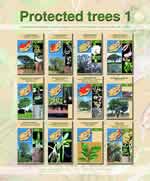
» download protected trees poster [23.2 mb]
Forests are more than just trees. They are vital for the health of the planet and the survival of all living things. If we take care of forests and manage them sustainably, they will continue to offer important benefits for us and future generations.
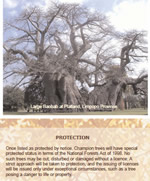
Forests are home to 70% of the world’s land animals and plants. • The Sagole Baobab is believed to be the biggest tree in South Africa. Located in Venda, Limpopo, this impressive tree is over 2000 years old and is being protected from extinction.
The large plantations across South Africa are all man-made forests. Typically, each tree in these forests, like the pine plantations around Sabie, was planted by hand. Most towns and cities also have trees that residents have planted over the years. These green spaces in urban areas can even be thought of as urban forests.
Countries have national symbols to how what makes them unique. You might see them during sport games or big celebrations to show pride in the country.
The yellow wood tree, also known as Podocarpus latifolus, is a protected tree species according to South African laws. The trees have been growing in South Africa for over 100 million years. They have gone extinct in some parts of South Africa. They are ever green and are indigenous to South Africa.
The yellow wood tree can grow up to 40 metres tall.